GOING ANALOGUE
the digital detox is now a content vertical. we investigated, hypocritically.
THE MOVEMENT
At some point this year a critical mass of people decided the answer was less.
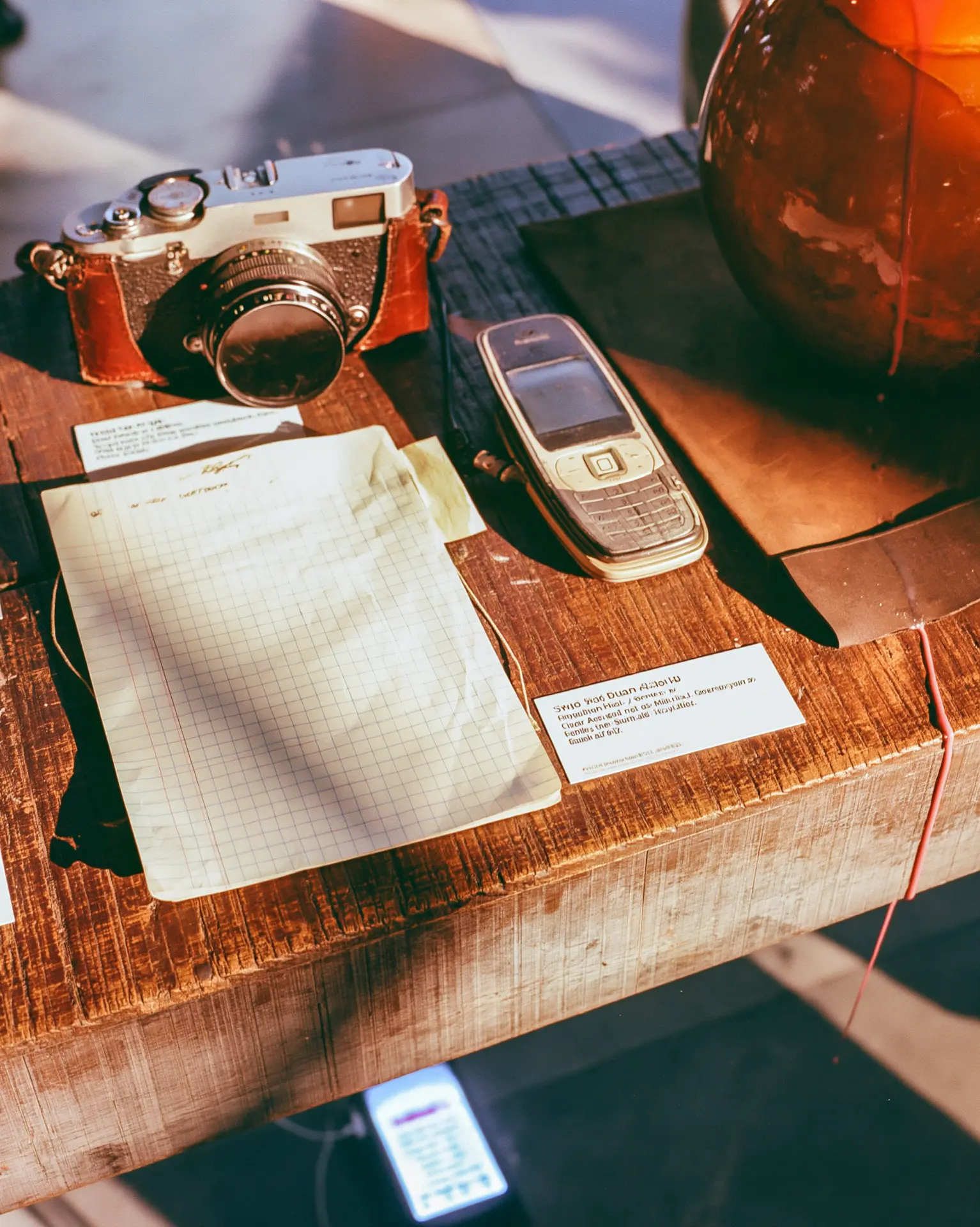
Screen time down. Film cameras — real ones, with rolls in them, developed by strangers at a shop. Flip phones carried semi-ironically and then, quietly, not ironically. Paper planners. Records. Books read in public, held at an angle where the cover is legible from a distance, which we will return to.
The stated goal is attention. The unstated goal is being the kind of person who has attention, and those two things are related but not identical, and the gap between them is where this entire field report lives.
THE CONTRADICTION AT THE CENTER
You already see it.
The digital detox is a content vertical. It has creators, formats, a visual language (grainy 35mm, natural light, a hand holding a paperback near a coffee), and a growth curve. There are people whose full-time job is producing footage of themselves not using their phone. The most successful going-analogue accounts post daily.
We are not raising this as a gotcha. It's a structural problem and everybody caught in it knows it: the only way to advocate for logging off, at scale, is to log on. There's no analogue distribution channel for the analogue movement. The pamphlet would have to be a post.
WHAT ACTUALLY WORKS
Before we make fun of anything, the sincere part, stated plainly and once:
Reducing screen time works. Not as a personality, as a mechanism. Attention recovers. Sleep improves when the phone leaves the bedroom. Boredom — actual, unmediated, staring-at-a-wall boredom — reliably produces ideas, which is why every writer for four hundred years has recommended walks. Film cameras make you take eleven photographs instead of four hundred, and you will look at all eleven, which is more than you will ever do with the four hundred.
None of this requires a movement, an aesthetic, or a purchase. That's the good news and also the reason it will never trend properly.
THE WEEKEND
We committed to forty-eight hours. Phone in a drawer. Laptop off. One paper notebook.
- Friday, 6:00 PM
- Phone placed in drawer. Immediate, physical sense of having left the house without pants. Investigator notes: "this is going to be fine."
- Friday, 6:11 PM
- Opened drawer to check the time. Closed drawer. Purchased no clock.
- Friday, 8:30 PM
- Read a book. Genuinely enjoyed it. Reached for phone four times to tell someone we were enjoying it.
- Saturday, 9:00 AM
- Woke without alarm, which was pleasant, at a time we can only estimate, which was not.
- Saturday, 11:00 AM
- Walk. No podcast. Noticed a building we have passed approximately four hundred times and have never once seen. It is orange. It has been orange this whole time.
- Saturday, 2:00 PM
- Boredom achieves critical mass. Reorganized a shelf that did not require it. Had two ideas. Wrote them in the notebook. One of them became this paragraph.
- Saturday, 7:00 PM
- Missed a group chat. Felt the specific dread of an ongoing conversation proceeding without us. Investigator notes: "the fear of missing out is not about the content of the conversation. we don't care what they said. we care that it happened."
- Sunday, 10:00 AM
- Best sleep in months. Cannot report this to anyone.
- Sunday, 3:00 PM
- Caught ourselves composing the post about the weekend. In the notebook. In advance. With the caption already written.
- Sunday, 6:00 PM
- Phone retrieved. Forty-one notifications. Read all of them in ninety seconds. None of them mattered. Felt worse immediately.
FINDINGS
Two things are true and the discourse insists on picking one.
Logging off is real and it works. Every part of the weekend that was good was actually good — the sleep, the orange building, the ideas that arrived only after two hours of nothing. Nobody who tries this is being fooled.
And: performing the logging off is a completely different hobby that happens to use the same equipment. It's not a moral failure, it's just a separate activity, and it is possible to do the second one entirely instead of the first one and never notice.
We went analogue for forty-eight hours and filed nine hundred words about it. Physician, heal thyself.
The orange building, though. That was free.
we went analogue for 48 hours and filed 900 words about it. physician, heal thyself.
the building is orange. it always was.
YOU MIGHT ALSO ROT ON

THE GREAT MEME RESET: A DIAGNOSIS
Teens wanted 2012 memes back. Here is what happened, what it meant, and why the cure was always going to become the disease.

WE FRIED THE DONUT
the glaze caramelizes. the timeline caramelizes. everyone is fine.
A VAN SWERVED ON A NORWEGIAN HIGHWAY AND ENDED A SEVEN-YEAR TREASURE HUNT
police stopped a van for driving erratically outside oslo. inside were tens of thousands of stolen american silver coins. a second van pulled up minutes later carrying the rest.