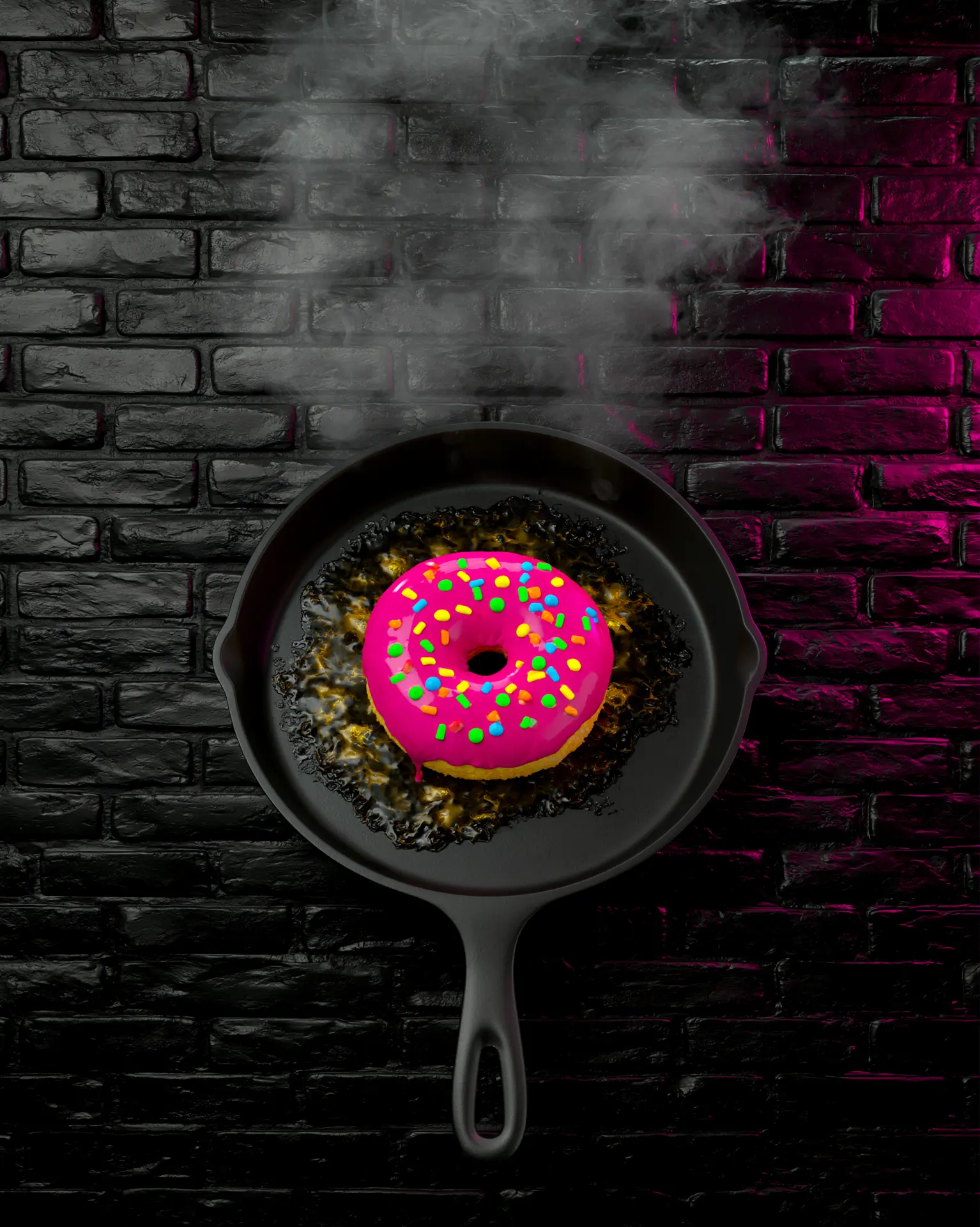
WE FRIED THE DONUT
the glaze caramelizes. the timeline caramelizes. everyone is fine.
THE DISCOVERY
The internet has found that if you place a glazed donut in a hot dry pan, the sugar on its exterior melts, caramelizes, and re-hardens into a shell — producing something structurally distinct from the donut you started with, and, according to every person who has attempted it, better.
We received this information at 11:40 on a Tuesday morning and immediately stopped all other work.
We want to establish our conflict of interest early, in the interest of journalistic integrity: this publication has spent its entire existence building a worldview around glaze. The glazed state. The condition of being coated in something sweet and slightly synthetic while the world proceeds without you. We have written thousands of words on this. We have a merch brand named after it.
And then the internet, with no warning and no credit, discovered that if you apply heat to the glaze, it gets better.
We are not going to pretend we were normal about this.
CONDITIONS
The lab: one apartment kitchen. One cast iron skillet of unknown provenance, seasoned by prior tenants who left no notes. Four glazed donuts of standard grocery construction, purchased that morning, room temperature. No oil, no butter, no additions — the hack is a dry pan and a small amount of nerve.
Medium heat. Ninety seconds a side. One participant present, later joined by a second who "smelled something."
THE SCIENCE, EXPLAINED BY SOMEONE CLEARLY GUESSING
Sugar, when heated past a certain point, stops being sugar in the way you understand sugar and becomes a series of increasingly complicated brown compounds that taste like nostalgia and slightly like a campfire. This process is called caramelization. It is not the same as burning, though the two share a border and the border is not marked.
The glaze on a commercial donut is thin, evenly applied, and mostly sugar and water. In a hot pan, the water leaves first, immediately, in a small hiss. What remains is a sugar film sitting directly on metal at a temperature it was never designed to encounter. It liquefies. It bubbles. It goes from white to amber to a color we can only describe as committed.
Then you flip it, and the underside — now cooled — forms a shell. A crust. A glass.
This is where the internet is correct. The textural contrast between shell and interior is not a marginal improvement. It's a different object.
FIELD TRANSCRIPT
- 11:52
- Donut one placed in pan. Immediate hiss. Investigator notes: "oh."
- 11:53
- Visible caramelization at the contact ring. Aroma described in notes as "a county fair with a secret."
- 11:54
- First flip. Shell confirmed. Investigator attempts to photograph and does not, because the donut is going in the mouth.
- 11:56
- Second investigator arrives. Does not ask questions. Is handed donut two.
- 12:04
- Donut three attempted at higher heat "to see." Result: carbon. Investigator maintains this was scientifically necessary.
- 12:19
- Donut four consumed standing over the sink. No notes recorded for this period.
- 12:41
- Investigators sit in silence. One says, "we should write this up." Neither moves for six minutes.
FINDINGS
The hack works. Do it on medium, do it dry, do it ninety seconds, and do not walk away — the window between amber and carbon is roughly the length of a text message.
But that's the food section's finding, and we're not the food section. Our finding is this: for two years we have been arguing that the glaze is not a coating, it's a state — the thin sweet film that forms over a person who has been consuming content at industrial volume and has stopped fully metabolizing it. We built a whole vocabulary for this. People thought it was a joke.
Then the entire internet independently discovered that the glaze is the best part, and that applying heat to it makes it a shell.
We're not saying we were right about everything. We're saying the pan agrees with us.
we have spent two years building a brand on glaze. the internet caught up in a skillet.
medium heat. ninety seconds. do not walk away.
YOU MIGHT ALSO ROT ON

THE GREAT MEME RESET: A DIAGNOSIS
Teens wanted 2012 memes back. Here is what happened, what it meant, and why the cure was always going to become the disease.
GOING ANALOGUE
the digital detox is now a content vertical. we investigated, hypocritically.
A VAN SWERVED ON A NORWEGIAN HIGHWAY AND ENDED A SEVEN-YEAR TREASURE HUNT
police stopped a van for driving erratically outside oslo. inside were tens of thousands of stolen american silver coins. a second van pulled up minutes later carrying the rest.