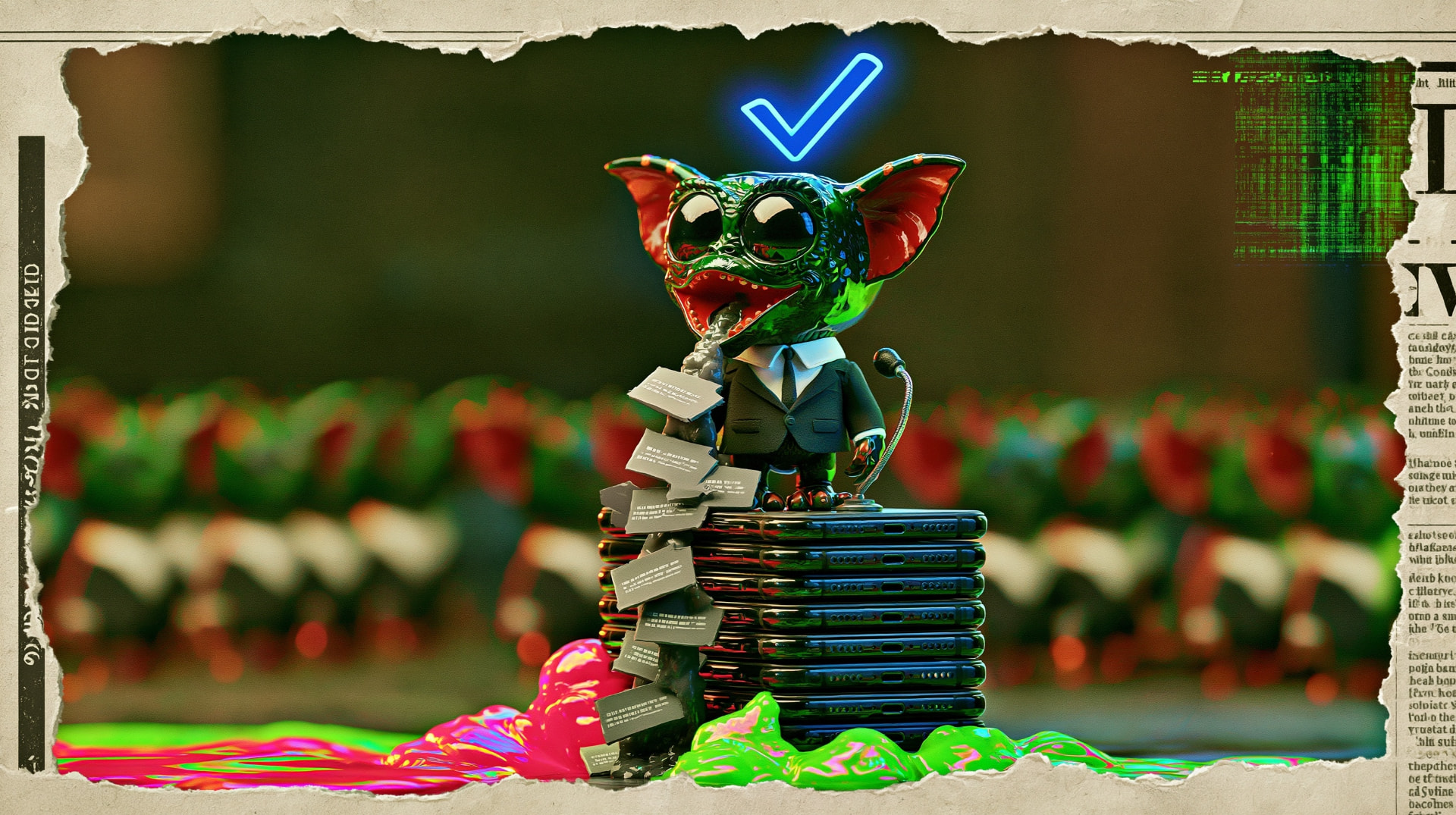
LINKEDIN BUILT A BUTTON TO REPORT ITSELF
Over a million presses in three weeks. The platform spent years shipping an 'enhance your post' button, then quietly removed it and shipped a button to complain about what it produced. Both buttons were on the same screen.
ABOMINATIONS — SPECIMEN #005 · Filed under: Referent Vacancy — Voice Without Speaker
THE SPECIMEN
Tap the three dots on any LinkedIn post. Scroll the menu past Save, past Copy link, past Report.
"Seems like AI slop."
That is a real button, on a real Microsoft-owned professional network, shipped on July 30th of this year. In its first three weeks, users hit it more than a million times.
A million. In twenty-one days. On a platform whose entire product thesis is that you should be professional here.
EXTERNAL EXAMINATION
Here is the sequence of events, in order, and we want you to notice that nobody involved appears to have found it funny.
Step one. LinkedIn spends several years aggressively integrating generative AI writing tools directly into the composer. There is a button. The button says enhance your post. You type a thought; the machine returns a better-sounding version of the thought; you ship it. The feature is promoted, surfaced, defaulted-toward.
Step two. The feed fills with the output. By 2026, analyses put more than 40% of long-form LinkedIn posts as fully AI-generated. Reports going back to 2024 pegged over half of posts above a hundred words the same way, and two years of remediation did not move that number.
Step three. LinkedIn deletes the enhance button. It is replaced with a proofreader.
Step four. LinkedIn ships a different button, in a different menu, whose function is to let you tell LinkedIn that a post looks like it came out of the button LinkedIn just deleted.
Step five. A million people press it in three weeks.
At no point in this sequence did the platform stop shipping buttons. That's the finding. The response to a machine problem was a machine, and the response to that machine was a machine.
INTERNAL EXAMINATION
Now the toxicology, because the numbers underneath this are worse than the joke on top of it.
Content creation on LinkedIn is up 14% year over year — growth driven substantially by the AI-assisted output the platform is now suppressing. The company reports blocking hundreds of thousands of automated comment attempts daily, and billions of broader automation attempts over recent months. Detection is claimed at 94% accuracy. False positive rates have not been disclosed, which means somewhere out there is a real person who writes cleanly, in complete sentences, with a three-part structure and a closing question, and the machine has decided they are a machine.
Zoom out and it's not one platform's problem. Pinterest, facing its own revolt, cited academic literature putting generative AI at 57% of all online material and shipped user controls to see less of it. Substack partnered with a detection firm to label AI writing. Digg's Reddit competitor shut down in March because it could not keep bots out of its own launch. Merriam-Webster made "slop" its word of the year for 2025, which is the kind of thing that happens when a language needs a word badly enough.
And the public has quietly gone sour. Gallup's 2026 numbers: 39% of Americans now say AI does more harm than good, up from 31% a year prior. Among 18-to-29-year-olds it's 47%, up from 36% last year and 27% the year before that. Trust that businesses use AI responsibly fell to 27%. Among the young, it fell to 20%.
That's not a technology backlash. That's a credibility backlash. People are not angry that the tool exists. They are angry about being handed a plausible-sounding slurry and told a colleague wrote it.
TOXICOLOGY
Fifth specimen, same organism, and this one is the purest expression of it we have logged.
The peanut butter cup with no peanut in it. The Sunday with no rest in it. The investigation with no investigator in it. The consent with no consent in it.
And now: the voice with no speaker in it.
Look at what survives in a slop post. Everything. The confident opening line, delivered on its own paragraph. The personal anecdote about a flight delay or a taxi driver. The pivot — and it made me realize something about B2B sales. The three bolded lessons. The line break cadence, one sentence per line, designed to look like poetry to someone who has never read any. The closing engagement bait: what do you think?
Every marker of a person having a thought is present, in high resolution, professionally formatted.
The thought is not there. There was never a thought. The format of insight has been fully decoupled from the event of insight, and the decoupled version scales infinitely and costs nothing.
The horror isn't that the machine writes badly. The machine writes exactly like the humans did. LinkedIn thought leadership was a genre of performed sincerity years before a language model touched it — the flight-delay parable, the humblebrag disguised as vulnerability, the "I'll say the unpopular thing" that is invariably the popular thing. The model didn't corrupt the form. It just noticed the form was already hollow and filled it faster than we could.
You cannot automate a genre that wasn't already a formula.
CAUSE OF DEATH
The button works, is the thing. That's what makes it a specimen and not just a laugh.
A million presses in three weeks means a million people confidently identified something as machine-written. Some of them were wrong. Some of them flagged a real human being who happened to write in the register the machine learned from real human beings. There is now a professional network where the highest-value skill is sounding sufficiently unlike the average professional to avoid being reported as a robot by your peers.
We have arrived at a place where you can be algorithmically punished for writing the way the platform spent three years training you to write.
VERDICT
Admitted. Tier 3, Referent Vacancy, and the only specimen in the wing where the institution built the diagnostic tool itself, shipped it, and then published the number.
We'll be fair, because it costs us nothing to be: removing the enhance button was the correct call, and doing it publicly was braver than most platforms manage. Somebody at LinkedIn looked at the thing they built and shut it off. That is genuinely rare.
But the shape of the fix tells you everything. The problem was too much machine. The solution was another machine, plus a button, plus a detection model with an undisclosed error rate, plus a number in a press release.
Nobody at any point suggested that people simply write less, and mean it more.
The slop was never the AI's fault. The AI just found the empty room and moved in.
ROT INDEX
- ABOMINATION CLASS
- Tier 3 — Referent Vacancy (Voice Vacancy subtype)
- SINCERITY READING
- 0.4 / 10
- COMMERCIAL CAPTURE
- 8.0 / 10
- WAS THIS ARTICLE WRITTEN BY A MACHINE
- No. You may press the button anyway.
REFERENT VACANCY — SPECIMEN INDEX
YOU MIGHT ALSO ROT ON
JOHNSONVILLE PUT DR PEPPER IN A SAUSAGE AND NOBODY STOPPED THEM
A real product. On shelves. Available for purchase. Right now.
THEY SHREDDED THE LETTUCE IN 27 STATES AND NOBODY STOPPED THEM
A parasite you cannot pronounce got into the one ingredient nobody wanted in the first place. The garnish has become the main character.
THE PEANUT IS DEAD AND WE HAVE KILLED IT
Liquid Death and Feastables built a peanut butter cup you cannot chew, cannot choke on, and cannot be allergic to. Ten calories. Zero peanuts. Infinite implication.