EVERYONE IS A DETECTIVE AND NO ONE IS LIABLE
230 million Americans consume true crime. Twenty-three thousand podcasts. A $29 mid-roll. And in Plymouth County right now, twelve people are doing the actual job the rest of us have been cosplaying.
ABOMINATIONS — SPECIMEN #003 · Filed under: Referent Vacancy — Justice Without Jurisdiction
THE SPECIMEN
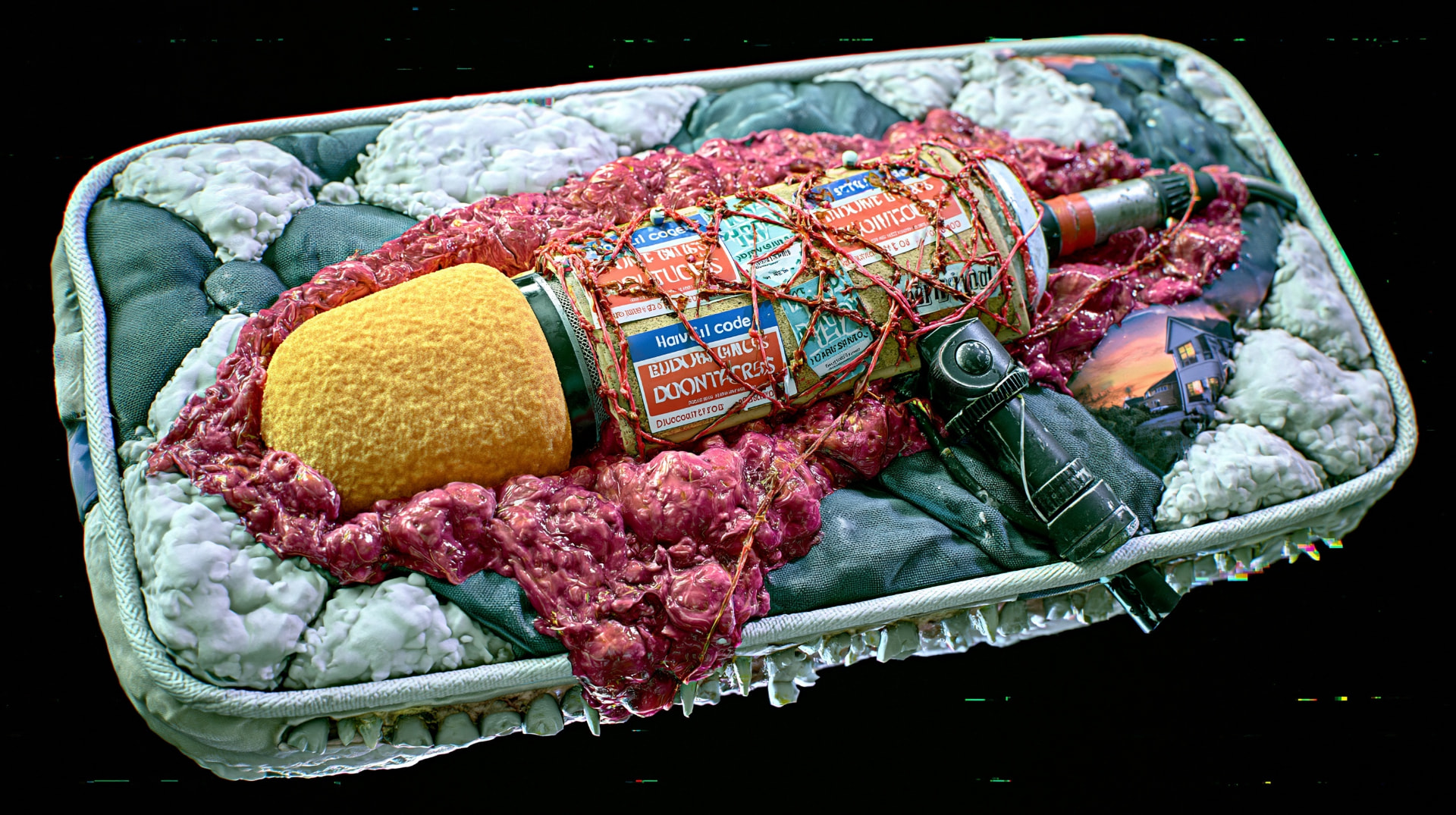
A drone shot of a house at dusk. Cello. A woman's voice, warm, close-mic'd, doing the specific vocal register that exists nowhere else in human speech — the Grave Voice, pitched somewhere between a hospice nurse and a girl telling you a secret at a sleepover.
And that's when investigators found…
Cut. Mid-roll. Same voice, same warmth, forty percent more energy:
But first — I have been LOVING my new mattress.
That's the specimen. Not the crime. Not the podcast. The seam. The two-second hinge where a dead person becomes a lead-in for a discount code, performed by the same larynx, at the same volume, with no acknowledgment that anything has changed.
Because nothing has changed. It was always the same product.
I. EXTERNAL EXAMINATION
The scale first, because the scale is not a niche.
Eighty-four percent of Americans aged thirteen and up consume true crime through some medium — an estimated 230 million people. It's a $2.4 billion U.S. industry generating roughly 2.1 billion social media interactions a month. There are over 23,000 true crime podcasts competing in 2026, and narrative true crime pulls the largest launch-day audiences of any new-podcast category. Mid-roll CPMs run $18 to $45; the average sits near $29. Host-read ads — the Grave Voice pivoting to the mattress — deliver measurably higher recall than pre-produced spots.
Read that last one again. The industry has quantified that grief makes a better ad wrapper than a normal ad. The tenderness is load-bearing. The tenderness is the delivery mechanism.
And here's where this specimen shakes hands with Specimen #002, because we did not expect these two files to touch and they touch hard:
The number-one listening moment is the commute, at 34%. The second is household chores, at 28%.
You are doing your Sunday Reset. The candle is lit. The towels are folding. And in your ears, a stranger is describing what was found in the basement. The wellness ritual is soundtracked by a homicide. The mop is sponsored, the murder is sponsored, and the through-line between them is a warm voice reading a code for twenty percent off.
II. INTERNAL EXAMINATION
Now the second organism, the one growing inside the first.
Half of true crime podcast listeners say they enjoy participating in solving the mystery. That figure is the whole disease in one line. Half the audience does not consider itself an audience. It considers itself staff.
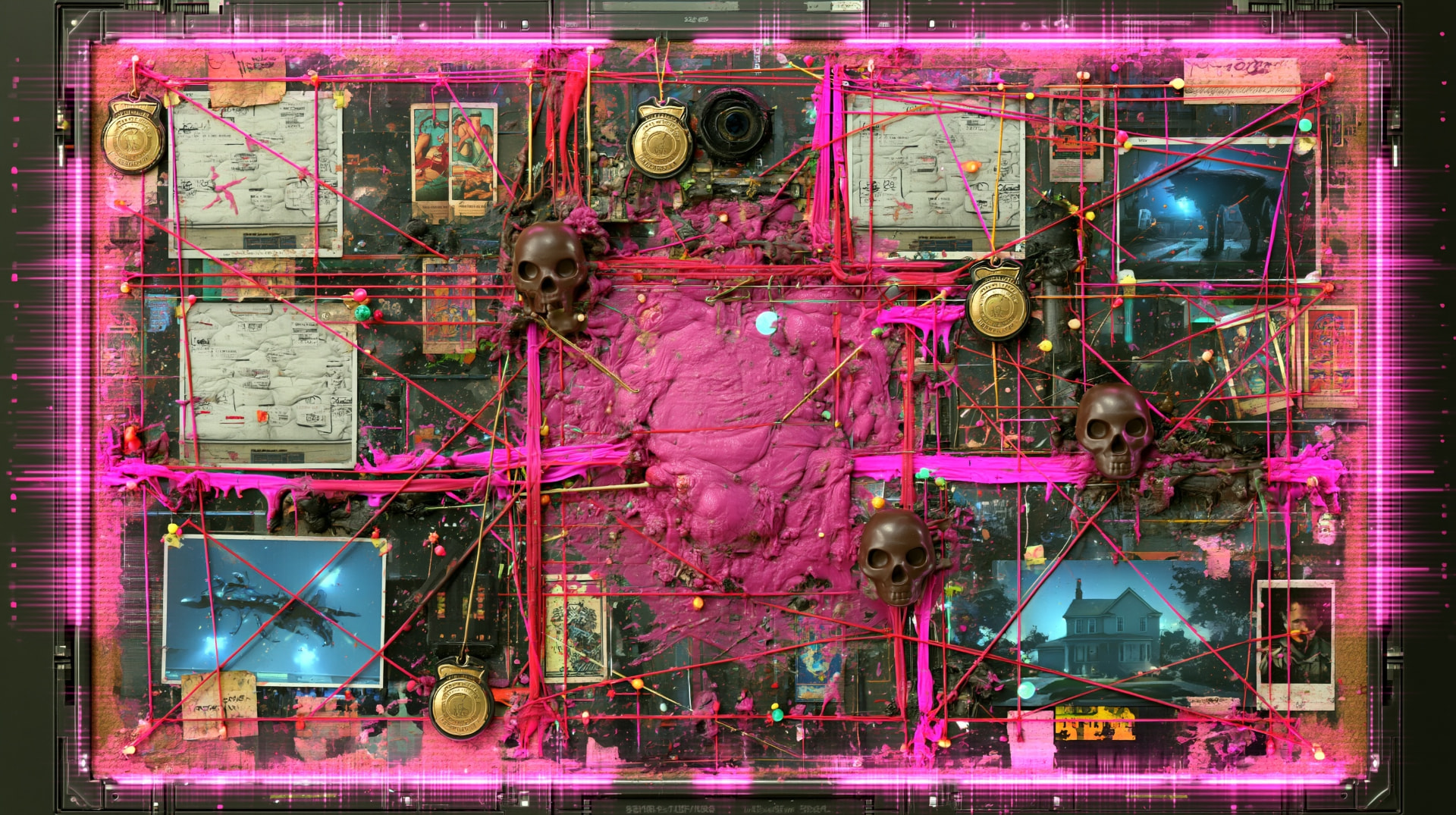
So they deputize. They open the app and they investigate — which in practice means scrolling a stranger's tagged photos from 2019 and announcing a theory to eleven thousand people. And because the format of investigation has been so thoroughly televised, they have all the props: the timeline, the map, the phrase "let's break this down," the corkboard energy, the confident forensic vocabulary deployed by someone whose actual credential is that they have watched a great deal of television.
What they do not have is any of the load-bearing parts. No badge. No oath. No burden of proof. No chain of custody. No bar association. No consequence.
Until February 27th, 2026, when there was one.
An Idaho jury returned a verdict against a Texas TikTok user — a self-described psychic with roughly 100,000 followers who had accused a University of Idaho history professor of orchestrating the Moscow student murders. The accusation was based on tarot card readings. It was seen by millions. There was no evidence. Police stated publicly the professor was not involved. She sued. She sent cease-and-desists. The videos stayed up.
The jury awarded her ten million dollars after a three-day trial.
That is the market price, established by a court of law in 2026, of a tarot reading performed at scale about a woman who did nothing. And in the same case, the two roommates who survived that night — cleared by police in multiple press releases — were accused by armchair detectives anyway, and driven into hiding by strangers who believed they were helping.
They wanted to be detectives so badly that they produced additional victims.
III. TOXICOLOGY
Third specimen, same pathology, and by now the pattern should be legible enough to hang on a wall.
The peanut butter cup with no peanut in it.
The Sunday with no rest in it.
The investigation with no investigator in it.
Every element of the apparatus survives. The somber score. The aerial establishing shot. The word allegedly, deployed as a magic ward. The timeline graphic. The hushed reverence for the family. The whole visual and sonic grammar of taking something seriously — perfectly preserved, beautifully produced, better lit than the actual local news.
What's been surgically removed is the part that costs something. The training. The liability. The oath. The ability to be wrong in a way that lands on you instead of on a history professor in Idaho.
You get the aesthetic of justice with the accountability excised.
IV. THE CASE THAT IS HAPPENING WHILE YOU READ THIS
We are dropping the voice here. Not as a bit. The register this section is written in is the register it will stay in, because the alternative is doing the exact thing this article is about.
In Plymouth County, Massachusetts, a jury is currently hearing the murder trial of Lindsay Clancy, 36, a former labor-and-delivery nurse. She is charged with three counts of first-degree murder in the January 24, 2023 deaths of her children: Cora, five. Dawson, three. Callan, eight months.
We are naming them once, here, deliberately, and we will not use them again in this article. They were people. They are not material.
The facts of the act are not in dispute. Clancy has admitted she killed her children with exercise bands in the basement of the family's Duxbury home while her husband was out picking up takeout and a prescription. She then cut her own throat and wrists and went out a second-story window. She survived, paralyzed from the waist down, and has been held at Tewksbury State Hospital since. Her attorney, Kevin Reddington, argues she lacked criminal responsibility — that severe postpartum illness and a cascade of medication changes meant she was not, in the legal sense, present. Prosecutors argue she planned it.
Jury selection began June 20. Testimony started July 27. The prosecution rested on August 17 after fourteen days. The defense is calling witnesses this week. Twelve people will have to reach a unanimous answer to one question — not what happened, but whether she can be held responsible for it — and they have not reached it yet.
Now watch what the machine did with that.

Court TV is livestreaming it day by day, numbered like episodes, under a branded alliterative nickname. A capital-stakes trial, in progress, packaged with a title card. Day 17. Day 18. The format of a season.
Prosecutors moved to obtain a New Yorker reporter's notes and recordings from an interview the husband gave about his wife's mental health. The coverage had become so entangled with the case that the court moved to enter journalism into evidence.
The judge had to issue an order specifically barring media from disseminating the 911 recording and the autopsy photographs. He ruled in the husband's favor. Read that plainly: a sitting judge in 2026 had to construct a legal wall to stop the content economy from getting its hands on the worst artifacts a father has. He would not have needed to build that wall if there were not people on the other side of it, reaching.
The judge also had to instruct the jury, twice in one day, after the defendant broke down in court — reminding twelve adults under oath that they must separate what they feel from what the evidence weighs.
That instruction is the whole article. A judge, in a room, having to say out loud: your emotional reaction is not evidence. Because that distinction — the single most basic requirement of actually adjudicating anything — has been so completely dissolved by the format we consume outside that room that it now has to be restated to people who swore an oath.
And here is the part we cannot get past.
Days after his children died, the husband, Patrick Clancy, released a public statement. He wrote about each of them individually. He noted that his wife was being characterized by people who had never met her. And he asked the public — a public that had already convened, already decided, already begun — to forgive Lindsay, as I have.
That was January 2023.
The machine ran for three and a half more years anyway.
V. WHAT WE ARE NOT GOING TO DO
We are not going to tell you what we think happened in that basement.
We are not going to tell you whether it was psychosis or premeditation, whether the medications did it, whether she should walk, whether the defense is real or a strategy. We have not seen the evidence. We have not heard fourteen days of testimony. We are not qualified to evaluate a postpartum psychosis presentation and neither, with respect, are you, and neither is the account with the ring light and the tarot deck, and neither is the comment section, and neither is the man in your replies who has watched a documentary.
Twelve people in Plymouth County are doing that job right now. They were selected for it. They took an oath. They are sitting in the room with the actual evidence, under a judge who has already had to remind them twice what their job is. Whatever they decide, they will have earned the right to decide it in a way that no one reading this has.
That refusal is not us being cowardly. It is the only sentence in this article that actually costs anything, because rendering the verdict is free engagement and we are declining to take it.
There is one genuine good in all of this, and it should be said clearly: this case has driven real public attention to perinatal and postpartum mood disorders, including postpartum psychosis, a rare condition that most people had never heard named. Actual clinicians have been given actual airtime. Some number of people have recognized something in themselves or in someone they love and gotten help. That is not nothing. That is the one clean thing the coverage produced.
But it did not require day-numbered livestreams. It did not require a nickname. It did not require anyone to subpoena a magazine.
VERDICT
Admitted. Tier 3, Referent Vacancy, and the largest specimen in the wing by mass.
Everyone reading this has listened to one. Us included. Nobody here is standing above the tank — the Rot has never once claimed to be outside the thing it's autopsying. We watch too. We just insist on writing down what we're doing while we do it.
So: you are not investigating. You are not helping. You are not on the team.
You are consuming other people's worst day in a warm voice at 1.5x while you fold the towels, and there is a mattress company paying twenty-nine dollars per thousand of you for the privilege of arriving at the exact emotional moment your guard is down.
Everyone is a detective. No one is liable.
And a father asked us to be gentle three and a half years ago, in writing, and 230 million of us did not read it.
ROT INDEX
- ABOMINATION CLASS
- Tier 3 — Referent Vacancy (Jurisdiction Vacancy subtype)
- SINCERITY READING
- 3.5 / 10 (the fear is real; the format is not)
- COMMERCIAL CAPTURE
- 10 / 10
- BODY COUNT OF THE CURE
- Non-zero
- VERDICT RENDERED BY THIS PUBLICATION
- None. That is the point.
REFERENT VACANCY — SPECIMEN INDEX
YOU MIGHT ALSO ROT ON
JOHNSONVILLE PUT DR PEPPER IN A SAUSAGE AND NOBODY STOPPED THEM
A real product. On shelves. Available for purchase. Right now.
THEY SHREDDED THE LETTUCE IN 27 STATES AND NOBODY STOPPED THEM
A parasite you cannot pronounce got into the one ingredient nobody wanted in the first place. The garnish has become the main character.
THE PEANUT IS DEAD AND WE HAVE KILLED IT
Liquid Death and Feastables built a peanut butter cup you cannot chew, cannot choke on, and cannot be allergic to. Ten calories. Zero peanuts. Infinite implication.