THE THING THAT SURVIVES BEING LAUGHED AT
Field notes on Idiosyncra electa, the organism that wins by refusing to flinch
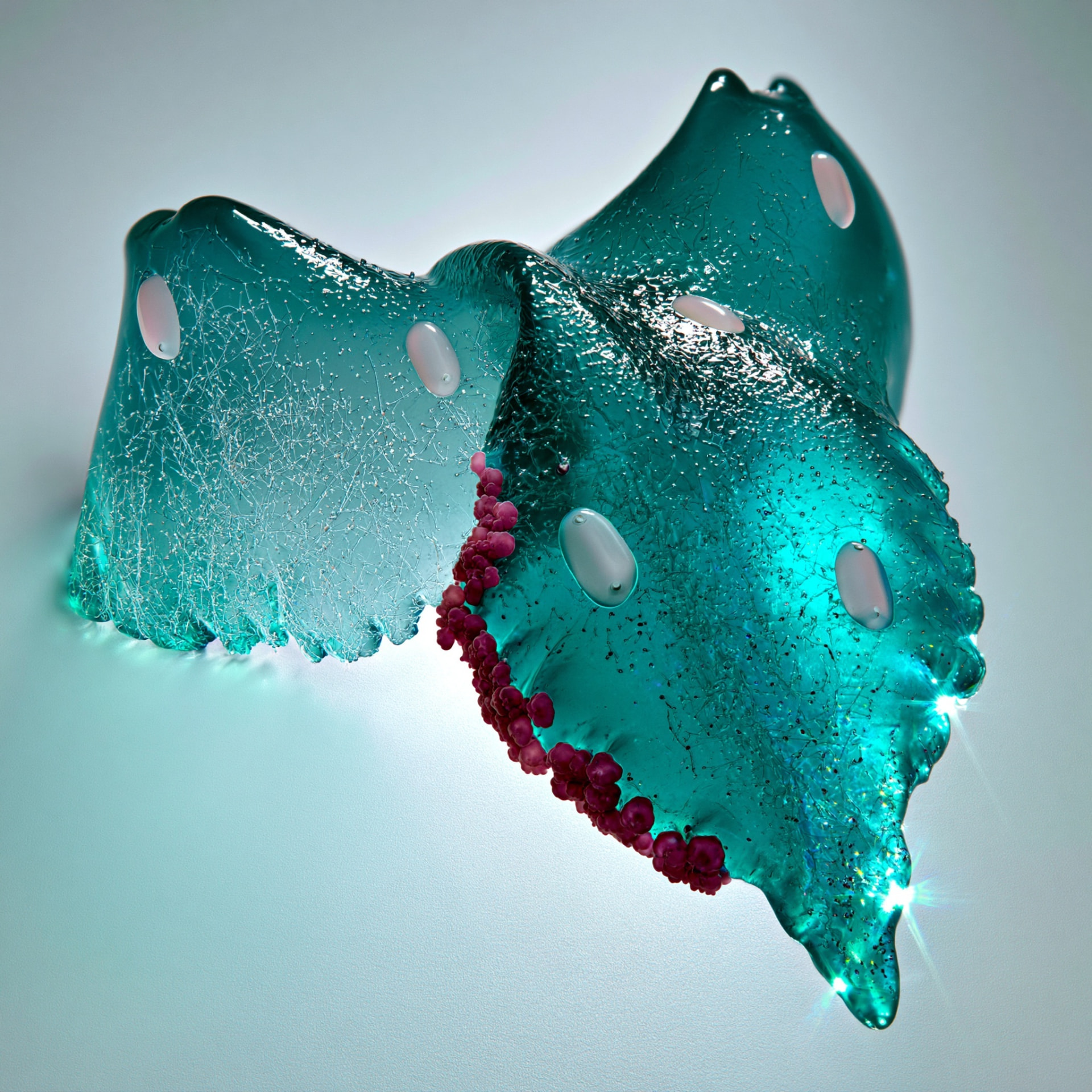
There is a moment, universally experienced and almost never discussed, where somebody laughs at something you're wearing.
Not a big laugh. That's the thing. A big laugh you could work with — a big laugh is an event, it has a shape, you can go home and have feelings about it. What actually happens is smaller and worse. Somebody's eyes go to the shoes and come back up half a second late. A friend says "oh, that's a look" with a very slight rise at the end. Somebody's mouth does something and then stops doing it.
And in that half-second, a decision gets made. Most people make it without noticing they made it.
The overwhelming majority of organisms, on receiving that signal, retreat. The shoes go in the back of the closet. Not thrown out — that would require admitting something. Just moved to where you don't see them, and then six months later you don't own them anymore and you couldn't say when that happened.
This is normal. This is the baseline behavior of nearly everything alive. Social animals read disapproval and adjust. It's not cowardice, it's function. The species that ignore feedback tend not to be around long.
But a small number don't retreat.
They do something we have watched hundreds of times now and still cannot fully account for: they wear the shoes again the next day. On purpose. Somewhere more people will see them.
We have catalogued this organism as Idiosyncra electa — roughly, the chosen peculiarity. It is the only specimen in Wing C that appears to feed on being disliked, and it has the fastest-growing population in the collection.
Collection Notes
Idiosyncra electa is nocturnal, though not in the usual sense. It's active in a specific and narrow window: the twenty minutes before leaving the residence. That's when it's most visible and most vulnerable, and it's where we've had the most collection success.
Standing at a bedroom mirror. The jacket's on. There's a version of the evening where the jacket comes off and something safer goes on instead, and that version is genuinely available, right up until it isn't.
The specimen keeps the jacket on.
Habitat: bedroom mirrors, thrift aisles, the back seats of cars where somebody's already said something. Diet: mild disapproval — and we want to be precise here, because this is the part that gets misreported. It does not feed on hatred. Hatred is too much; hatred is a whole meal and the specimen chokes on it. What it metabolizes is the small stuff. The pause. The "interesting." The half-second delay before the compliment.
Its call is a four-word phrase, delivered flat, usually without eye contact:
no this is a choice
We've recorded thousands of instances. The delivery is remarkably consistent. There's no defensiveness in it — defensiveness would mean the specimen was still negotiating. This is closer to a correction. Somebody has misfiled the thing as an accident, and the specimen is updating the record.
The Mechanism
Here's what we can't explain properly.
The thing becomes good.
Not immediately, and not always, and not for everyone — but with enough frequency that we've had to stop treating it as coincidence. The jacket that got the pause in March is the jacket somebody asks about in July. The way of talking that a specific person made a specific face about becomes the way three other people are talking by autumn.
We have no mechanism for this. We have theories, and they're all a bit unsatisfying.
The best one we have is that taste is largely a confidence-reading exercise wearing the costume of an aesthetic judgment. When most people encounter an unfamiliar thing, they aren't evaluating the thing — they don't have the tools, nobody does, nobody knows if the shoes are good. What they're actually doing is scanning the person for signs of doubt, and using that as the reading.
Doubt reads as mistake. Absence of doubt reads as reference you don't have.
Which means the specimen's refusal to flinch isn't a response to the judgment. It's an input to it. The specimen is not enduring the evaluation. It is, quietly and without seeming to try, conducting it.
We stress that this is a theory. What we know for certain is only this: the organism gets mocked, does not stop, and the thing becomes good. We have watched the sequence too many times to call it anything else.

Status: Thriving
Population increasing, and increasing faster than in any prior collection period.
We should say plainly that we did not predict this. The models suggested the opposite — recommendation systems reward legibility, and the pressure on every organism in the feed is toward the recognizable. There is no obvious reason for a specimen that succeeds by being disliked to be doing well in that environment.
Our current working explanation: when everything is optimized for approval, disapproval becomes the only reliable signal that something real is present. A thing nobody has an opinion about is a thing nobody made a choice about. In a habitat saturated with content that has been sanded down to offend no one, the small friction of a genuine choice reads as evidence of a person.
There's a version of this that's a triumph and a version that's grim, and we don't think we get to pick. Both are in the data.
Field Note
The specimen decided the thing was good.
The thing became good.
We do not fully understand this, and we have stopped pretending that we do.